Table of Contents
Every week at our corner of Avenue A and East 4th Street, the same scene plays out in the chair. Someone sits down, pulls up a photo, and says "just a fade," and the barber asks three questions before touching a clipper, because "a fade" describes about forty different haircuts. The taper, the fade, and the skin fade are three different commitments, three different maintenance schedules, and three different messages your head sends the world, and the fastest way to walk out with the wrong one is to use the words interchangeably.So here is the guide we give in person, written down. After 15 years of cutting every head the East Village brings through the door, this is the real difference between the three, which one fits your hair and your life, and exactly how to ask for what you actually want.
The Ladder, In One Minute
Think of the three cuts as a ladder of shortness at the sides and back. The taper is the top rung: hair gets gradually shorter toward the ears and neckline, but it never disappears, and the shortest point still shows hair. The fade is the middle: the sides blend from longer up top down to very short, often a number one or two guard, with the gradient itself as the visual feature. The skin fade is the bottom rung: the blend travels all the way down to bare skin, the sharpest and boldest version, where the transition from skin to hair is the entire statement. Same family, three different altitudes, and everything else in this guide is detail on that one idea.The Taper: The Gentleman's Default
The taper is the most conservative of the three and the most forgiving. Hair shortens gradually around the ears and at the neckline while the sides keep visible length, which means no stripe of scalp ever shows, the grow-out is nearly invisible, and the cut reads as intentional in every room from a boardroom to a wedding.Who it suits: professionals in conservative fields, anyone whose office skews formal, men easing back into shorter sides after years of longer hair, and gray-haired gentlemen who want sharpness without severity. It is also the safest first stop for anyone who has never gone short, because a taper that feels too tame this month becomes a fade next month with zero awkward phase in between.Maintenance truth: a taper stays presentable for four to five weeks, the longest runway of the three, which makes it the lowest-commitment cut on this page.The Fade: The East Village Standard
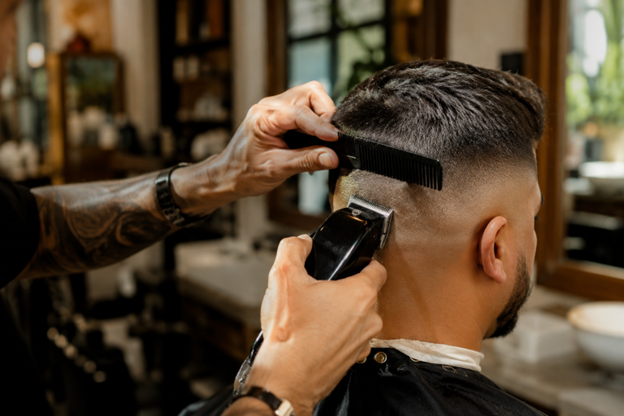
The fade is what most people picture when they say the word, and it comes in three main heights that completely change the result. A low fade starts the blend just above the ears, keeps most of the side hair, and stays subtle. A mid fade starts around the temple line, the crowd favorite, balanced between clean and bold. A high fade starts near the top of the head, removes most of the side hair, and turns the contrast itself into the style.Within the family live the specialty versions our chairs handle daily: the burst fade curving in a semicircle around the ear, usually under longer or textured tops, and the drop fade dipping lower behind the ear to follow the head's natural curve. Every one of them lives or dies on blending, the barber's ability to erase any visible line between lengths, which is exactly the skill that daily volume builds and the reason a shop that cuts fades all day beats a shop that cuts them occasionally.Who it suits: almost everyone, honestly, which is why it rules the neighborhood. Thick hair, curly hair, and wavy hair all carry fades beautifully because the short sides remove bulk while the top keeps the texture. Fine hair benefits too, since the contrast creates an illusion of density up top.Maintenance truth: three to four weeks before the gradient softens noticeably. The fade is a relationship, not a purchase.The Skin Fade: The Sharpest Tool in the Shop
The skin fade takes the blend all the way to bare skin, usually finished with a foil shaver or a blade for that glass-smooth transition, and it is the boldest, cleanest, most photographed cut on this ladder. Done right, the gradient from skin to hair looks airbrushed. Done wrong, every mistake is visible from across the street, which is why this is the cut where the barber matters most and where our chairs earn their keep.Two honest notes before you commit. First, the skin fade shows everything: fresh, it is immaculate; at week three, the regrowth line announces itself, so this cut demands the tightest maintenance schedule of the three, ideally every two to three weeks. Second, skin means skin, so a fresh skin fade plus a beach weekend equals a sunburn map of your haircut. Plan accordingly.Who it suits: anyone who wants maximum sharpness, athletes and gym regulars who value the clean feel, beard wearers, because a skin fade blending into a shaped beard is one of the strongest looks in men's grooming, and every man whose reference photo has that barbershop-fresh gleam.Which One Should You Actually Get?
Match the cut to three things: your hair, your job, and your calendar. Hair type: curly and thick hair loves fades and skin fades, which control bulk while the top does the talking; fine or thinning hair often looks fullest with a mid or high fade, and a taper flatters nearly everything. Workplace: conservative office leans taper or low fade; creative or casual field, anything on the ladder; client-facing role where crispness is currency, the mid fade is the eternal safe bet. Calendar: if you will realistically visit the shop every two to three weeks, the skin fade rewards you; if monthly is your truth, the taper forgives you; the fade sits happily in between.And if you are genuinely torn, here is the chair-side advice we give daily: start one rung higher on the ladder than you think you want. A taper can become a fade next visit, and a fade can drop to skin whenever you are ready, but the reverse trip requires weeks of waiting. Shortness is easy to add and impossible to subtract.How to Ask for It: The Sixty Second Script
Walk in and cover four things. The rung: taper, fade, or skin fade, using this guide's definitions. The height: low, mid, or high, or just point to where the shortest part should start. The number: if you know clipper guards, name the shortest one you want, a two for subtle, a one for sharp, zero or skin for maximum; if you do not, the photo does the job. The top: what happens above the fade matters just as much, so say whether the top stays as is, gets scissor work, or comes shorter too.Bring the photo from the front and the side, because these cuts are defined by the profile, and mention how your hair behaves when you do nothing to it, since the barber is designing for day ten, not just day one. At our shop the consultation costs nothing and the prices are posted on the wall and on our services page, so the only surprise in the chair is how good the mirror looks at the end.Keeping It Sharp Between Visits
Three habits stretch any of these cuts. Wash with actual shampoo two or three times a week rather than daily, because over-washed scalps overproduce oil and short hair shows it. Learn your product: a matte paste or clay for textured tops, next to nothing for the sides, because product on a fade just makes scalp shine. And resist the home clipper touch-up around the ears and neckline, because every professional gradient survives exactly until someone evens things up in the bathroom mirror. When the neckline blurs between full visits, a quick walk-in cleanup takes ten minutes at any East Village barbershop worth its chairs, and ours has been holding this corner for over 15 years with walk-ins welcome every open day and Sundays from 10 to 7.Frequently Asked Questions
What is the difference between a taper and a fade? A taper shortens hair gradually only around the ears and neckline and never exposes scalp; a fade blends the entire sides and back down to very short lengths, with the gradient as the visible feature. Every skin fade is a fade, but no taper is. How long does a skin fade last? The immaculate window runs about two weeks, with most men booking every two to three weeks to keep the transition clean. Tapers stretch to four or five weeks, and regular fades sit in between at three to four. Which fade is best for curly hair? Curly hair carries mid fades, high fades, and burst fades exceptionally well, because the short sides control bulk while the curls provide texture up top. The key is a barber who cuts curly hair daily, which in the East Village is a job requirement. Do fades work on older men or gray hair? Absolutely. A taper or low fade is one of the sharpest looks a gray-haired man can wear, adding structure and intention without the severity of exposed skin. The consultation determines the right height for the face and the profession. Can I get a fade as a walk-in in the East Village? Yes. Our shop at 60 Avenue A takes walk-ins every open day, with online booking available for planners and Sunday hours from 10 AM to 7 PM, and the full neighborhood guide to our barber shop in East Village NYC 10009 covers the corner, the trains, and everything else worth knowing before you sit down.